Digital Printing vs Offset Printing — The Decision That Matters Most
Almost every cost and quality decision in book printing comes back to this one choice, and almost no first-time author has heard of it before they start.
Digital printing works the way a high-end office printer works, just at commercial scale — each copy is printed individually, with no setup cost for plates or colour calibration beyond the first run. This makes it the right choice for small quantities, typically under 300 copies. If you're testing the market, producing advance review copies, or printing a niche title where you genuinely don't know if 100 copies will sell, digital is how you avoid sinking money into stock you can't move.
Offset printing is the traditional commercial method — ink transferred via plates onto large sheets, which are then cut and bound. The setup cost is higher because plates have to be made and colour calibrated before a single copy comes off the press. But once that setup is done, the cost per copy drops sharply as quantity increases. This is the standard method for anything going into real bookstore distribution, because the per-unit economics only make sense at volume.
The crossover point in Malaysia tends to sit somewhere around 300 to 500 copies. Below that, digital usually wins. Above it, offset almost always does.
What Printing Actually Costs — And Why the Range Is So Wide
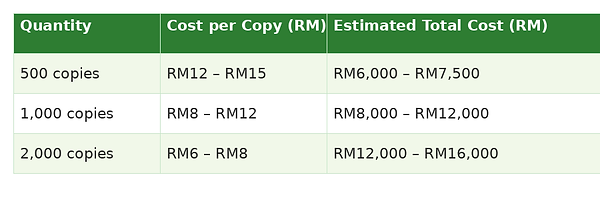
For a standard 200-page black and white interior softcover book, here's roughly where the numbers land on offset printing:
That's the baseline. The moment you move into full colour interior pages — children's books, cookbooks, photography-driven titles, anything with charts or infographics throughout — those numbers can climb 40% to 100% higher, because every colour page requires four separate plates (cyan, magenta, yellow, black) instead of one, and the press has to run more carefully to keep all four aligned. A book with colour only on a handful of pages costs meaningfully less than one that's colour throughout, so it's worth being deliberate about which pages actually need colour rather than defaulting to all or nothing.
Hardcover runs roughly double the baseline figures on top of whatever the interior colour adds, because binding, board thickness and cover lamination all add cost on their own.
And then there's finishing. Matte lamination versus glossy lamination on a cover costs roughly the same as each other, but they read completely differently to a reader picking the book up — matte feels premium and quiet, glossy feels punchy and commercial, and the right choice depends entirely on genre and positioning, not personal preference. Spot UV — a glossy raised coating over specific design elements like a title or icon — adds a noticeable cost per copy but creates a tactile, eye-catching effect that's hard to replicate any other way. Foil stamping, often used for a title or author name in gold or silver, and embossing, which presses a raised or recessed design into the cover stock, both require a separate die to be made and a separate pass through production — meaning they add both setup cost and per-copy cost, and that cost barely changes whether you're printing 500 copies or 2,000, since the die cost is fixed regardless of quantity.
The Paper Cost Problem Nobody Talks About
Here's something that catches even experienced authors off guard: paper cost in Malaysia isn't fixed. It fluctuates — sometimes significantly — based on global pulp prices, currency exchange rates and supply availability, since most of the higher-grade art paper used for premium book printing is imported rather than locally produced.
This means a quote you got six months ago isn't necessarily the price today. It also means that two printers quoting the same job can come back with genuinely different numbers, not because one is overcharging, but because they're sourcing paper from different suppliers who bought their stock at different times, in different quantities, under different exchange rate conditions.
For an author managing this alone, that volatility is just something you absorb — you get a quote, you pay it, you hope it doesn't change too much by the time you're ready to print. For a publisher managing many projects across many printers, it's something that can actually be worked around.
The Decisions Most Authors Don't Know They're Making
Paper weight and stock. Interior pages are usually specified in gsm — grams per square metre. 70 to 80gsm is standard for text-heavy books, light enough to keep page count manageable without the book feeling flimsy. Anything lighter starts to feel like newsprint. For books with photographs or heavy graphics, 100 to 128gsm matte or silk art paper gives images real depth, though it adds noticeably to both weight and cost — and as above, that cost moves with the paper market, not just with your print quantity.
Trim size. The actual physical dimensions of the book. Malaysia generally follows two common formats — A5 (148mm x 210mm) for most non-fiction, self-help and business titles, and a slightly larger trade format for titles wanting more presence on a shelf. Trim size isn't just aesthetic. It affects how many pages fit per printed sheet, which affects cost, and it affects how the book physically sits next to other titles in its category at MPH or Popular.
Binding type. Perfect binding — the flat-spine glued binding most paperbacks use — is standard for anything over about 50 pages. For anything meant to sit upright and readable on a shelf with a printed spine, perfect binding is the only real option, and the spine width has to be calculated precisely based on page count and paper thickness or the text on the spine ends up misaligned.
Colour calibration. The colour you see on your laptop screen and the colour that comes off a printing press are genuinely different things, governed by entirely different colour systems — RGB for screens, CMYK for print. A cover that looks vivid and punchy on screen can come back from the printer looking flat or slightly off if the files weren't properly converted and proofed before the full run. This is why a physical proof copy before committing to a full print run isn't optional.
Why Print Quantity Decisions Matter More Than Authors Expect
The instinct for a first-time author is almost always to print conservatively — better to print less and reorder than be stuck with unsold stock, right? That instinct isn't wrong, but it misunderstands how the cost curve actually works.
Printing 300 copies at RM20 each costs RM6,000. Printing 1,500 copies at RM9 each costs RM13,500 — more than double the money, for five times the books. If your distribution plan genuinely supports 1,500 copies moving over the following year, the second scenario produces a far lower cost per unit and a much better margin on every copy sold through a bookstore.
The real question isn't "how do I minimise risk by printing less." It's "what does my actual distribution and marketing plan support." Getting the print quantity right depends entirely on having clarity on where the book is actually going to sell, which is why printing decisions should never be made in isolation from the distribution plan.
Reprints — The Conversation Nobody Plans For
A book that sells through its first print run faster than expected creates a real problem: the bookstore wants to reorder, and there's a gap of several weeks before more stock is available. That gap is pure lost momentum — readers who wanted the book when it was selling well move on, bookstores get frustrated waiting, and the sales curve that should have kept climbing flattens out while everyone waits for the reprint.
A reprint isn't just "print more of the same file." It's worth using the gap to fix any errors caught in the first run, update anything time-sensitive, and sometimes adjust pricing or cover elements based on early feedback. But none of that matters if the reprint timeline itself is slow.
Why Working With a Print Manager Actually Saves You Money
Here's the part most authors don't realise until they've already overpaid once: there is no single "best printer" in Malaysia. There's a best printer for a 500-copy black and white softcover run, a different best printer for a 2,000-copy full-colour hardcover run with foil stamping, and a different one again for a small digital run of an illustrated children's book.
Finding the wrong printer doesn't just risk a slightly disappointing result. It's expensive in two separate ways at once — you can end up with poor quality, you can end up overpaying, and very often both happen on the same job, because the two are usually connected.
Here's what's actually happening behind a lot of printing quotes that an author has no way to see from the outside.
The printer may be sitting on expensive paper stock. Paper isn't bought job by job — printers buy in bulk, often months ahead, at whatever the market price was at the time. If a printer bought their current stock when paper prices were high, that cost gets passed straight through to you, regardless of whether better-priced paper is available elsewhere right now. You'd have no way to know that unless you were comparing quotes across several printers at the same time — which most authors printing one book, once, never do.
The equipment might be the wrong fit for your specific job. A press built for high-volume offset runs is inefficient and overpriced for a short 300-copy digital job, and the reverse is just as true — a small digital setup straining to handle a 2,000-copy run will be slow and the per-unit cost won't reflect the efficiency you should be getting at that volume. Matching the right machine to the right job is something a printer with one type of equipment simply can't always do, no matter how good their intentions are.
Older, less efficient machines cost more to run — and that cost lands on you. A press that's slower, less precise on colour, or more prone to misfeeds and waste isn't just a quality risk. The inefficiency is baked into the price you're quoted, because the printer has to cover their own higher running cost somehow.
Capacity matters more than most authors realise — timing is a real cost factor. A printer whose schedule is fully booked will quote you a premium rate, because they don't need your job and they know a rushed slot costs more to squeeze in. A printer with spare capacity that same month might quote significantly less for the exact same specifications, because they want the work. An individual author going direct to one printer has no visibility into which situation they're walking into. They just get the number that printer happens to be charging that week.
Binding is very often outsourced — and marked up before it reaches you. Many printers don't actually have in-house binding capability. They print the sheets, then send them to a separate binder, and the cost of that binding gets marked up before it's passed on to you as part of the final quote. Going "direct" to a printer doesn't necessarily mean you're cutting out a middleman — sometimes the printer themselves is the middleman for that part of the job, and you're paying their markup without knowing it.
This is exactly why AcePremier operates as a print manager rather than locking every project into a single in-house printer. We work across a network of paper suppliers, printers and binders built up over years of running multiple projects through all of them — which means for every title, we know who currently has the better-priced paper, who has spare capacity this month versus who's fully booked and charging premium rates, who has the right equipment for your specific quantity and finish, and who does binding in-house versus outsourcing it.
We've helped a number of authors save real money this way — sometimes thousands of ringgit on a single print run — simply by routing the job to the printer actually suited to it, instead of the first or only printer an author happened to find.
And there's a second, equally important benefit that has nothing to do with cost: accountability. AcePremier has an established, ongoing relationship with every printer in this network. If something goes wrong — a delay, a quality issue, a finish that doesn't match the proof — there is real leverage to get it fixed, because we are a repeat client whose future business matters to that printer. A first-time author printing one book has none of that leverage. If a printer delivers late or delivers poorly, an individual author's only real options are to accept it or walk away — neither of which gets the book fixed or out on time. Working with someone who already has skin in that relationship changes what happens when something doesn't go to plan.
Frequently Asked Questions
What's the difference between digital and offset book printing in Malaysia?
Digital printing suits small quantities — typically under 300 copies — with no setup cost but a higher price per copy. Offset printing has higher setup costs but the price per copy drops significantly at volume, making it the standard for books going into bookstore distribution.
How much does it cost to print a book in Malaysia?
For a standard 200-page black and white softcover book on offset printing, costs typically range from RM6 to RM15 per copy depending on quantity. Full colour interior pages, hardcover binding, and finishing such as matte or gloss lamination, spot UV, foil stamping or embossing all add to that baseline cost.
Why does my printing quote keep changing? Paper cost in Malaysia fluctuates based on global pulp prices, exchange rates and supply availability, since much of the higher-grade paper used in book printing is imported. A quote can shift even between two close dates if the underlying paper cost has moved.
Should I print in colour or black and white?
This depends on the content. Text-heavy non-fiction rarely needs colour throughout. Children's books, cookbooks and photography-driven titles usually do. Colour only on select pages, rather than the whole book, is often the most cost-effective middle ground.
How many copies should I print for my first run?
This depends on your distribution plan rather than a fixed rule. Printing should be sized to match realistic bookstore and online sales volume — too few copies risks a costly mid-momentum reprint, while too many without a sales plan risks unsold stock.
Why work with a publisher instead of going direct to a printer?
Going direct to a single printer means accepting whatever paper stock, equipment, capacity and pricing that one printer happens to have right now — with no visibility into whether a better-suited option exists elsewhere, and no leverage if something goes wrong. A publisher acting as a print manager works across a network of paper suppliers, printers and binders, matching each project to whichever combination offers the best cost, quality and timing fit — something a first-time author printing a single run has no practical way to access alone.
Printing decisions affect cost, quality and how your book performs once it's actually on a shelf. If you're planning a print run and want an honest recommendation on paper, finishing and budget for your specific book, get in touch for a free consultation.